
.png)

Public transit ‘refresh’ a tweak, not an overhaul | The Homepage
Proposal is less drastic, but Hazelwood residents concerned about changes to the 93 line
By Ziggy Edwards and Juliet Martinez
Pittsburgh Regional Transit has proposed a lite version of the complete overhaul it proposed in 2024. The “Bus Line Refresh” proposes boosting service to popular routes and adding connections between Allegheny County communities. This update would cut 13 routes but add nine new ones. The transit authority was previously known as Port Authority Transit and is now often called PRT.
According to PRT, 16,000 riders, operators and community members gave their feedback on the Bus Line Redesign process launched in 2023. Many of the critiques that emerged focused on the changes being too drastic and confusing. The Bus Line Refresh attempts to dial back the drastic changes.
“We heard clearly that the original proposal felt like too much, too fast,” said PRT CEO Katharine Kelleman. “The network didn’t need a complete redesign — it needed a refresh. We focused on making service more frequent, more reliable and better aligned with how people travel today.”
The new proposal shifts 10% of service hours away from routes with very low ridership. Routes with more demand get 10% more hours. The proposal keeps 99.2% of current riders within a quarter mile of transit service. Just over 90% of riders near the Bus Line Refresh stops will still have a one-ride trip to Downtown. Saturday service is boosted by 20% and Sunday service by 18%. The proposal adds 16 new routes that operate every 30 minutes or less, and 39 new no-transfer rides regionally.
PRT used a tool called the Equity Index of Mobility Need to prioritize neighborhoods with higher transit dependence. Through this analysis, the new proposal adds 30-minute transit service to 195,000 people in those areas. This is a 28% increase. And 380,000 more jobs are now accessible by buses that run every 30 minutes.
During this final planning phase, PRT will host more than 60 meetings and pop-ups across Allegheny County this spring. This summer, the required public hearings will happen.
Riders can explore proposed changes using the Find My Route tool and interactive map at buslinerefresh.com. Riders can also preview their trip on the Transit App through early May. If approved by the PRT board this fall, the changes will go into effect next year.
“We’re going above and beyond to make sure this network works for the people who use it most,” Ms. Kelleman said. “Bus Line Refresh keeps what works and strengthens connections for the future.”
Worst-case scenarios
The new proposal’s focus on Oakland and Downtown will serve many riders. But Tameeka Jones-Cuff of Glen Hazel is concerned about getting to UPMC Children’s Hospital in Lawrenceville and the effects of the changes on parents, kids, and disabled and elderly riders.
Ms. Jones-Cuff is a mother of four who lives in Glen Hazel. She and her family rely on public transportation. Three of her children have disabilities, and she uses a cane. So getting to health care providers is a high priority. During a March 11 phone call, she painted the following picture:
“You are taking a sick child to the hospital on the bus because you do not have money for an Uber,” she said. “Now you have a sick child and a 30- to 60-minute wait. That’s providing that there’s connectability, that the buses are on time and you can connect from one to another like you should.”
Although she can currently take a no-transfer trip to Children’s on the 93, she can’t trust that the bus will come on time, she said. If a transfer is required under the new plan, missing that connection will cost another 40 to 60 minutes of waiting, potentially in cold or wet weather.
“What about the seasons changing? If you’re going to wait outside with a sick or disabled person, it’s kind of ridiculous,” she said. “I think about disabled people, the elderly, children, and how they get to these places.”
Ms. Jones-Cuff said the Bus Line Refresh site interface could be better, too. The map did not allow users to zoom in on roads where the bus routes completely changed. Riders in those areas may have to walk a significant distance to reach a pickup location, she said.
But she appreciates that people can leave feedback directly on the site. It asks site visitors to suggest ways to improve the plan and make it more accessible. “I can see they’re trying to work with the communities to get this right,” she said.
But ultimately, she was disappointed that even though she attended many of the meetings for the Bus Line Redesign, some things were changed that she didn’t expect.
“They said they weren’t changing the 56, 57 and the 93. We went to every meeting to make sure that wouldn’t get changed, but there are still big changes.”
Tom Weber is another public transit rider who was concerned about the Bus Line Redesign. A retiree, he rides the 56, 57 and 53 lines most days. He is usually going from his home in Hays to the Hazelwood Healthy Active Living Center or to medical appointments. He told The Homepage in December 2024 that if the 56 route were cut, he would be stuck at home.
Mr. Weber said he has a history of depression. He credits his busy schedule with keeping him healthy and happy during his retirement. “My involvement here at the center has basically saved my life. I’m able to do so much because my mental health has been so good from being active. It’s a circle.”
He wrote in an April 7 email that he had gone through the new proposal and the routes he relies on are not changing too much. He appreciated that.
“The 53/53L route changes are both positive and negative,” he wrote. He does not need to go into Mifflin Estates, then to Greenfield Avenue and Downtown, but likes that the option is there. The weekday service bypassing The Waterfront will not affect him, though he does use that route to travel from there to Lincoln Place or Walmart several times a month.
“It is the eliminating of the 53L weekend service between Walmart and The Waterfront that will disenfranchise a lot of riders,” he wrote. But overall, he said, the current proposal is better thought-out than the last one.
‘Leave the 93 alone’
Ben Nicklow, a senior planner at PRT, spoke about the Bus Line Refresh at the April 14 Hazelwood community meeting. This was one of the events PRT is holding to get people’s reactions to the revised plan.
The current 56 and 57 routes will become D56 and D57 respectively, and will not change much.
The 56 in particular, Mr. Nicklow noted, is an example of how PRT scaled back or eliminated changes in the Bus Line Redesign based on feedback from riders.
“This route was nothing like this in [draft proposal] 1.0. This is almost identical to what it is now,” he told the hybrid audience on Zoom and at the Spartan Center. “We heard loud and clear that [people in] Lincoln Place want to get to McKeesport, and McKeesport likes this route to get downtown.”
The existing 56 route’s high ridership likely convinced PRT to leave it as-is. It may not be known as a busy route, but it is, Mr. Nicklow said.
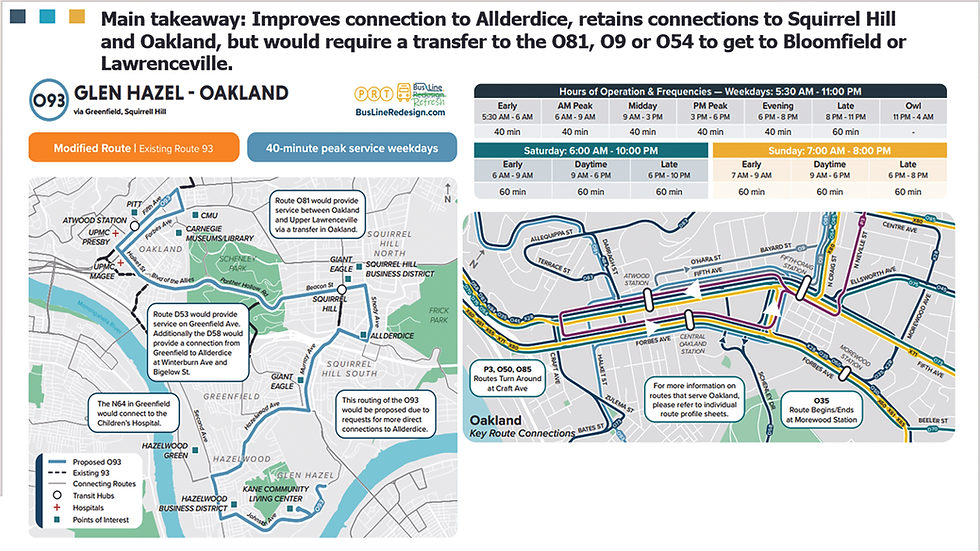
Hazelwoodians at the meeting echoed Ms. Jones-Cuff’s concerns about changes to the 93.
The presentation slide summed up the changes this way: “Improves connection to Allderdice, retains connections to Squirrel Hill and Oakland, but would require a transfer to the O81, O9 or O54 to get to Bloomfield or Lawrenceville.”
“Why would they take the most important stop off?” asked Ursula Craig of Hazelwood. “The 93 needs to go to Children’s Hospital.”
“I feel for the parents whose kids get sick,” Hazelwood resident Lula Cope echoed after the presentation. “They should leave the 93 alone. That’s not fair.”
Denise Johnson, who said she rides all three Hazelwood routes, seconded Ms. Craig’s comment. Ms. Johnson also said that eliminating the counterflow lane on Fifth Avenue is already causing problems for riders trying to get to the Oakland hospitals on that street. They now have to get off the bus on Forbes Avenue and walk an extra block uphill.
“These are people who are sick, who are pushing walkers or strollers,” she said.
Mr. Nicklow responded that PRT wouldn’t be able to change that part of the bus rerouting. It had to do with a grant PRT received for the University Line, but he did not go into details.
Mr. Nicklow briefly included O73 among the routes accessible to riders in the neighborhood. “I know it is not a direct community route, so I don’t want to stop on this one too long,” he said.
To get to the South Side as the Bus Line Refresh proposes, riders would catch the D56 or D57 in Hazelwood and transfer to the O73 at the corner of Bates Street and Second Avenue. The O73 crosses the Hot Metal Bridge to the South Side Flats. (See above.)
“We were not able to pull off a one-seat ride for South Side, but we’re able to make it happen quicker and easier than it was in the first draft,” Mr. Nicklow said. Although he didn’t mention it, people can also catch the O73 going in the other direction to access Lawrenceville and Bloomfield.
“What I can see so far is that the ‘Refresh’ is mostly meant to serve the Oakland corporations masquerading as non-profits,” lower Greenfield resident Ray Gerard commented. “Pitt, CMU and UPMC should contribute millions per year, every year, toward PRT’s budget so that working people can commute to work and back in a reasonable amount of time, rather than all of us subsidizing them.”
Bigger-picture critique
The advocacy group Pittsburghers for Public Transit praised the Bus Line Refresh on its blog for making less drastic changes and incorporating public feedback on previous drafts. But the group said the transit authority needs to focus on addressing bigger problems, like long-term funding, reversing cuts, improving communication and increasing ridership and reliability.
The post recalls the Transit Development Plan in 2009. This was aborted because of a transit funding fiscal cliff. New routes that had just started had to be rolled back, and others were never implemented. At that time, PRT had to cut 15% of transit service. This meant 29 routes were cut, 37 were reduced, and a bus garage was closed. Pittsburghers for Public Transit says it would be unfair to put riders through major changes again only to abandon them for lack of funding.
It goes on to say the status quo is simply not enough. The group describes the current state of transit service in Allegheny County as “beyond austere,” and at the lowest levels since the first half of the last century. Putting this “cost-neutral design” in place will lock in cuts that should be reversed.
“We are shuffling deck chairs on the Titanic and forcing unconscionable choices about which community will get more transit service at the expense of others, when all communities need and deserve more,” the post reads.
Ziggy Edwards is a citizen journalist and resident of Four Mile Run who proofreads every issue of The Homepage.
Juliet Martinez is the managing editor of The Homepage.


Comments