
.png)

Bus line ‘refresh’ offers mixed bag to transit riders | The Homepage
Cost-neutral proposal increases service to some neighborhoods, makes drastic cuts in others

By Ziggy Edwards
Pittsburgh Regional Transit held an in-person hearing on Sept. 10 during the final public comment period on its Bus Line Refresh. The transit authority also got more than 16,000 online comments about the plan before comments closed on Sept. 30. It was previously known as Port Authority Transit and is now branded PRT.
PRT’s board expects to vote on the changes in November and implement them in the second half of 2027.
The most recent version of the Bus Line Refresh cuts 20 routes and adds 14. PRT said in a statement to WPXI News that the plan “would retain service for 99.4% of our current ridership.” But the authority acknowledged on its project page that “demand for transit in our region exceeds the funding, staffing and operational capacity we’re able to provide.”
Laura Chu Wiens, executive director of Pittsburghers for Public Transit, told the PRT board her organization cannot fully endorse the Bus Line Refresh. Despite the hard work and good intentions behind PRT’s proposal, Ms. Wiens said, “A cost-neutral plan creates winners and losers.”
How did communities served by The Homepage fare in this latest plan? It’s a mixed bag.
South Side connection for 57 line
Today the 57’s inbound route goes through Hazelwood and Hazelwood Green before entering Downtown by way of Second Avenue. The new route would leave Second Avenue to cross the Hot Metal Bridge into the South Side and make stops along East Carson Street. Then it would cross the Smithfield Street Bridge into downtown. The Downtown route and stops would change, too.
This adjustment to the 57 resembles one that transit advocates and Hazelwoodians have been requesting for years: Extending the 75 from the South Side into Hazelwood. One-seat bus service between the two neighborhoods, which does not exist today, would give riders from Hazelwood access to the South Side Giant Eagle and Aldi.
Tom Weber, a frequent bus rider who lives in Lincoln Place, said he thinks PRT made a good decision with the 57. “It really opens up the possibilities for more ridership because it hits the South Side,” he said during a Sept. 16 phone call.
58 not serving Lower Greenfield
The 58’s new route would eliminate stops on the lower part of Greenfield Avenue. The nearest stop for riders who live in The Run or Lower Greenfield, like Ray Gerard, would be Winterburn Avenue.
For Mr. Gerard, that’s a 12-block walk up a steep hill.
“I go to work carrying heavy tools,” he told the PRT board on Sept. 10. He said it seems the new route would stop short of where he goes on the 58 now. After getting dropped off in South Oakland, he will have to walk about 20 more blocks to work.
“See, the fact that it takes me on average two hours to get home from work after working very hard days is insane. It’s absolutely insane,” he said, adding that his work and home are only about three miles apart. “So, if you continue to make these changes, I don’t know how I’m going to get to work and back.”
Greenfield is listed among the communities Pittsburghers for Public Transit identifies as most impacted by transit service loss. It’s mainly because of this change.
“[The revised 58] does do much less in the heart of Greenfield. The Run loses access. It does go into Squirrel Hill South to include the Greenfield Giant Eagle and Swisshelm Park, ending at the Wilkinsburg bus station,” Ms. Wiens commented. She said the route is slated to change so much that it’s hard to tell whether it will be better or worse overall. “It’s a different set of destinations.”
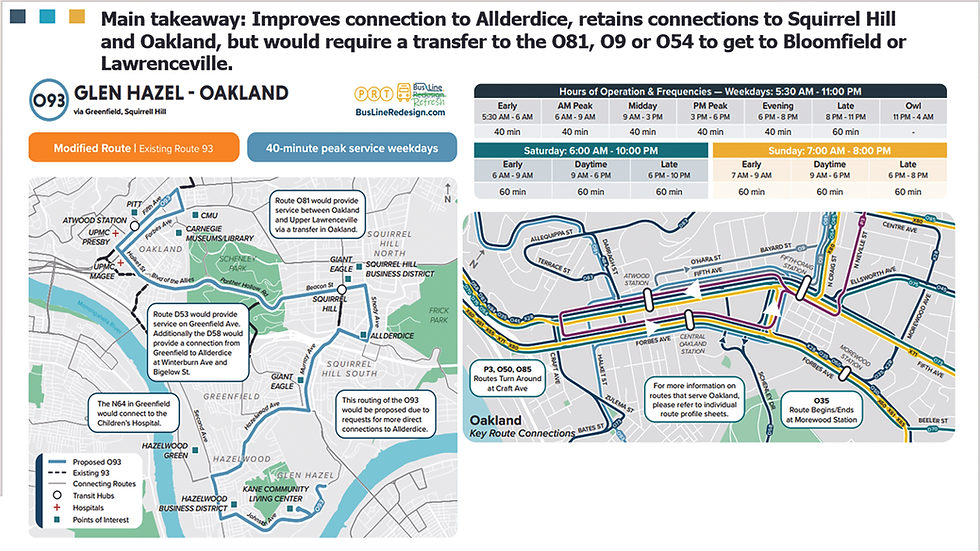
In this plan, the only bus line serving Lower Greenfield would be the 53L. Riders affected by this change get a reprieve for at least another year, however. The 58 and 93 will both run along Greenfield Avenue for as long as the Charles Anderson Bridge is closed.
Routes serving the 31st Ward
Mr. Weber rides the 53/53L and said he likes the route changes between the Waterfront and downtown. He sometimes takes the 56 to catch the 53, then uses the 53 to get to Homestead. From there, he can take the 57 to the Hazelwood Healthy Active Living Center. “With these changes, I can still do all that,” he said.
Best of all, Mr. Weber said, “I’m very happy that they are not touching the 56, my main route. That’s a good decision because it’s used by a lot of people from McKeesport to downtown.”
The only potential negative change he faces is with the Y46.
“I don’t use it that often, but I do use it for doctor appointments,” he said. The Y46 rerouting means Mr. Weber would now have to take the 53 to the West Mifflin Walmart and transfer to the 55 to get to his appointments. The service would be more fragmented and take longer, he said. “I’ll have to make sure I leave earlier.”
The trouble with transfers
One concerning change for Hazelwood riders has not been reversed in this version of the Bus Line Refresh: losing the 93’s one-seat ride to Children’s Hospital and other Lawrenceville destinations. To get there, riders would have to transfer in Oakland.
Pittsburghers for Public Transit Digital Organizing Director Dan Yablonsky commented at the Sept. 10 hearing that today’s bus system gives 85% of riders a one-seat ride. “The number of transfers the redesign asks for is far higher,” he said.
Mr. Yablonsky pointed to steep ridership drops at other times when PRT has increased bus transfers. And these routes were in places like Oakland where many bus lines come through frequently. In other neighborhoods, dangerous conditions and long wait times put even more hardship on riders.
Uptown resident Alisa Grishman, a wheelchair user, told the PRT board that her commutes already involve hassles such as drivers waiting for passengers to board before lowering the ramp for her and some accessible seats not functioning properly.
“As bad as it is now, imagine these little delays accumulating and bogging down the entire system once there are twice as many transfers,” she said.
A fight for funding
Pittsburghers for Public Transit continues to press PRT to focus on addressing bigger problems like long-term funding, reversing cuts, improving communication and increasing ridership and reliability.
Ms. Wiens emphasized that there can’t even be a redesign if PRT does not secure more state funding.
“The most ludicrous piece of this is if we go through this process and then have to revert to a -35% plan,” she said.
Last year, transit systems across Pennsylvania narrowly avoided deep funding cuts. PennDOT granted PRT $106.7 million in capital funding to support its operating budget. PRT states on its 2025 funding crisis webpage that it planned to “use this funding to plug a $100 million hole in its 2025-26 operating budget and use the remainder — plus a mix of state and local funding, and reserve funds — to stave off the proposed cuts for two years.”
A similarly sweeping Transit Development Plan was aborted in 2009 because of a transit funding fiscal cliff. The proposed bus changes at that time became 15% service cuts across the board.
“PRT should advocate for not cutting service,” Ms. Wiens said, adding that it would be better to tell the state what PRT needs for a better system.
Ben Nicklow, a senior planner at PRT, admitted in a Sept. 15 email that planners have had to make some difficult choices.
Asked whether PRT plans to advocate to state legislators for additional funding, he replied: “There is a section of the plan that focuses on what we would do with 20% more funding. There are not specifics, rather ideas like more frequent routes, more direct connections, etc.”
Specifics are exactly what Pittsburghers for Public Transit says PRT’s approach is missing.
“We are imploring you to put forward a really robust and fleshed-out plus 20% plan to offer to legislators, to inspire legislators to [address] this absolutely foreseen transit funding fight that we’re having this coming year so that we don’t have to negotiate somebody’s lives in these other communities against the needs of riders in the city,” Ms. Wiens told the PRT board.
“Everybody deserves more transit,” she added. “We have just lost so much.”
View the full plan at engage.rideprt.org/buslineredesign.
Ziggy Edwards is a citizen journalist who lives in Four Mile Run and proofreads every issue of The Homepage.


Comments